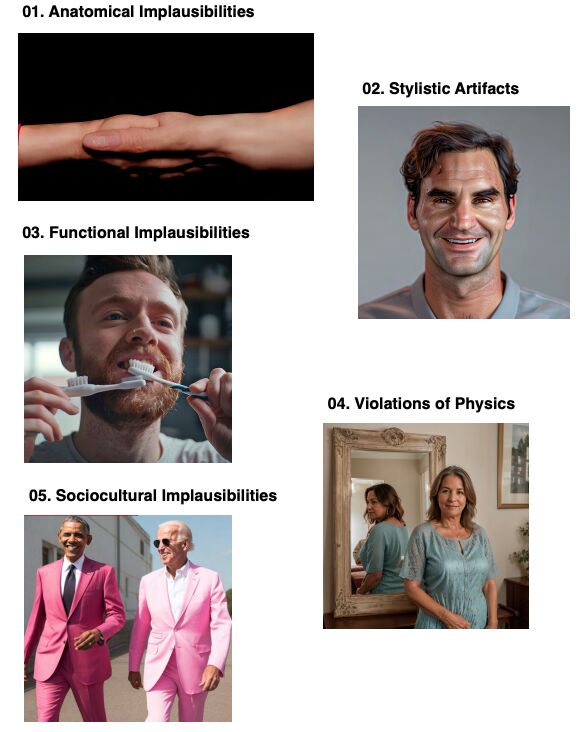
It is becoming difficult to distinguish whether some images are real or generated by AI. On first glance, many AI-generated images appear real. However, a second look often reveals a number of artifacts and implausibilities that can help a critical viewer identify that an image was generated by AI.
🚩 Shoutout to incredible research by Negar Kamali, Karyn Nakamura, Angelos Chatzimparmpas, Jessica Hullman, and Matthew Groh from Northwestern University (June 2024) who created an accessible guide for this exact purpose.
🚩 Quick AI Background: Diffusion models (like Midjourney, Stable Diffusion, DALL-E) work by starting with random noise and gradually refining it into coherent images through structured denoising.
🚩 Key Implausibilities to Watch For in the AI created images:
—> Anatomical Issues: Extra/missing fingers or limbs; Unnaturally glossy eyes; Overlapping lips/teeth and my favourite: Merged bodies
—> Stylistic Red Flags: Unnaturally perfect skin; Overly dramatic/picturesque scenes; Inconsistent color & resolution; Unnatural detail levels (especially hair)
—> Functional Problems: Distorted or nonsensical text; Violations of mechanical principles; Odd spelling/unconventional symbols
—> Physics Violations: Inconsistent lighting & shadows; Impossible reflections; Depth/perspective distortions
—> Sociocultural Inconsistencies: Unlikely scenarios; Historical/cultural inaccuracies
💡 Remember: Even authentic photos can sometimes appear implausible, and portrait images are particularly tricky to assess.
Check out their guide with tons of visuals – it makes everything crystal clear: https://lnkd.in/dSV7UHb4